
Acts of Becoming
Belfast Exposed is honoured to present a solo exhibition Acts of Becoming, by the renowned artist Rosy Martin.
Martin’s work challenges what it means to become visible on one’s own terms. Across more than four decades, she has used photography, performance, self-portraiture, still life and re-enactment in phototherapy. It questions how identities are formed, represented and remembered. Rather than presenting identity as settled or singular, her photographs reveal the self as layered, contradictory and continually changing. The works (Acts) are shaped by memory, family, class, gender, sexuality, ageing, loss and desire. At the core of Martin’s practice is a belief that dominant modes of female representation need to be challenged and remade. By entering the image herself, she opens up its meaning and creates new ways of seeing and being.
A photograph fixes a fraction of a second, but the self it appears to describe is never fixed. Across more than four decades, Martin has explored this tension between still image and a life in motion. Acts of Becoming brings together work concerned with memory, home, loss, grief, ageing and embodiment. Its title names the process at the heart of Martin’s practice: the self is continually made and remade.
Martin’s approach emerged from the politically engaged photographic culture of Britain in the 1980s, when artists were challenging the authority of documentary photography and the apparent innocence of the family album. In 1983, working with Jo Spence, she began to develop re-enactment phototherapy. Drawing on co-counselling, the two women alternated between the roles of photographer/therapist/witness, and sitter/subject/director. They used gesture, costume, props and staged situations in which to revisit, explore, retell and shift experiences that conventional portraiture and family photographs had hidden or simplified.
Martin’s collaborations with Spence addressed childhood, health, family mythology, class and being lesbian. Long before identity and representation became central concerns within contemporary art and wider cultural debate, they questioned who held the power to create images, whose bodies were permitted to be visible, and how class, gender, sexuality, illness and ageing shaped the ways people were seen. Their work anticipated many of today’s conversations, while also developing practical and collaborative methods through which inherited representations and restrictive identities could be challenged, reimagined and reclaimed.
This method also changed the balance of power usually found in portrait photography. The person before the camera was not a passive sitter waiting to be interpreted by an expert photographer. They evolved a process for re-enactment phototherapy. The work arose out of counselling sessions in which an issue of concern was identified, a scenario envisaged and a transformation identified. The ‘story’ was enacted in front of the camera whist the photographer also acted as therapist and witness. The therapeutic aim is a shift, a transformation of an old, stuck, painful ‘story’ to reach greater awareness.
Re-enactment does not claim to retrieve an untouched or objectively true past. Memory is fragmented, unstable and shaped by later experience. Martin’s constructed scenarios acknowledge that instability. Their theatricality is purposeful; utilising performance makes it possible to give form to feelings and identities previously suppressed, disallowed or left outside the frame. Anger, class shame, desire, vulnerability and resistance can be embodied, witnessed and represented. The resulting image engages with what the past continues to mean now. Works including ‘Double Exposure’, ‘The Minefield of Memory’ and ‘Transforming the Suit; What Do Lesbians Look Like’ questioned the demand that a portrait should reveal a single coherent person. Instead, they presented identity as multiple and contingent. The body could become a site on which social expectations were rehearsed, but also a means of refusing them. This was both a feminist and queer intervention that challenged the authority of the traditional photographer as a singular expert, whilst exposing the rules through which women were expected to appear, behave and understand themselves.
Re-enactment phototherapy is a structured and demanding practice concerned with power, consent and the conditions under which a person can revisit difficult experiences. It does not offer the photograph as a cure. It creates a critical space in which an inherited story can be examined, embodied, challenged and re-evaluated. The photograph is part of this exchange. Authorship is shared, and looking becomes an accountable act. After Spence’s death in 1992, Martin continued to develop this method and extended it towards ageing, bereavement and grief. That collaborative structure of portraiture remains one of Martin’s important contributions to photographic practice.
In ‘Too Close to Home?’, the domestic interior becomes an archive of labour, creativity, aspiration and family tension. Rooms and objects carry traces of absent people. The home is neither a neutral setting nor a private world detached from politics; it is where class, gender and family roles acquire material form. By returning to these spaces of her childhood, using still life photography and video Martin examines how attachment persists and how personal memory intersects with a wider social history. This attention to presence and absence continues through ‘In Situ’, ‘Acts of Reparation’, ‘End of the Line’ and ‘Letting Go’. The camera can preserve a gesture or object, yet it cannot restore what has disappeared. Martin does not treat grief as a straightforward passage towards closure. Her images remain with the repeated negotiations of mourning: the impulse to hold on, the recognition that something has ended, and the difficult work of changing one’s relationship to what remains. Reparation, in this context, does not erase damage. It names the act of returning to an experience and finding another way to live alongside it.
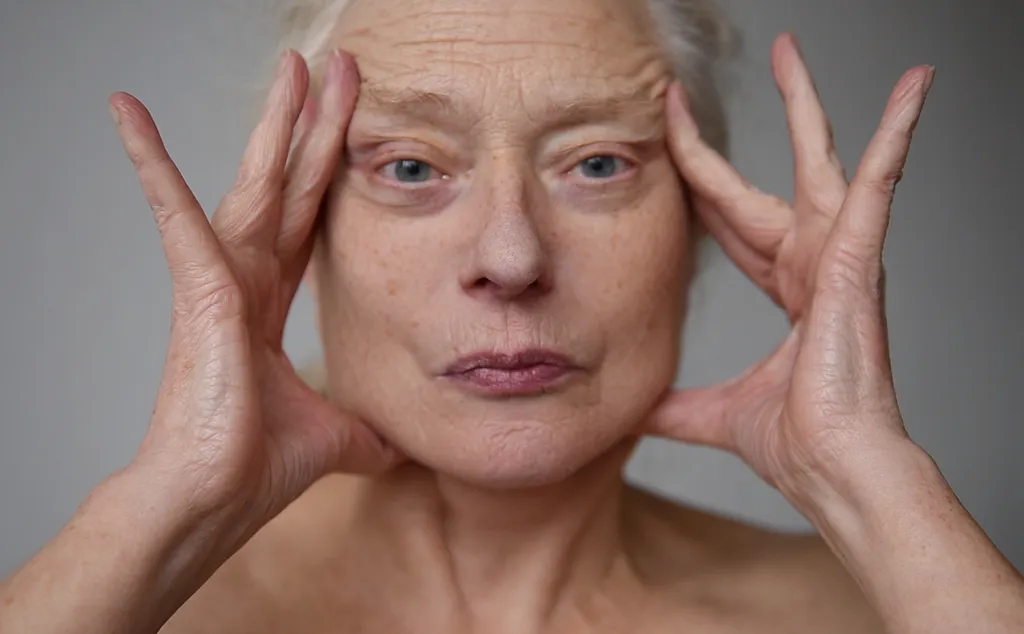
Ageing is another central concern. Through projects such as ‘Outrageous Agers’, made in collaboration with Kay Goodridge, Martin contests the cultural invisibility imposed on older women. She uses performance and humour to resist the narrow roles made available to the ageing female body. The work refuses both idealisation and pity. Ageing appears as lived experience shaped by health, sexuality, desire, dependency, pleasure and public policy. By placing an older woman’s body at the centre of the image, and projecting perjorative and affirming texts upon it, the words only become visible when they intersect with the body. Flesh answers back. Martin insists upon its complexity and its right to be seen on its own terms.
‘I Didn’t Put Myself Down for Sainthood’, made with Verity Welstead in 2018, brings many of these concerns together. It was prompted by the experience of being the carer for her mother during her multi-infarct dementia years. Its title rejects the expectation that women should become endlessly patient, self-sacrificing or morally exemplary. Martin claims room for anger, ambivalence, resignation, humour and desire. The work also confirms that collaboration is not a secondary feature of her practice. It is an ethical position. The photograph is shaped through an encounter between people rather than claimed as the product of a single authoritative gaze. The collaborative character of Martin’s career extends across her work with artists, students, workshop participants and therapy clients. It also complicates the way photographic history is written. It asks institutions to reconsider histories built around the idea of the solo artist.
Tate Britain’s recent exhibition programme has brought Martin’s contribution into sharper public view. Women in Revolt: Art and Activism in the UK 1970 to 1990, shown 2023-2024, included ‘Transforming the Suit; What Does a Lesbian Look Like’ and ‘Unwind the Lies That Bind’. The 80s: Photographing Britain, placed Martin and Spence’s collaborative phototherapy within a wider account of photography as political action and social critique. Earlier, ‘Libido Uprising’ appeared in the BP Spotlight Jo Spence display at Tate Britain in 2015 and 2016. with Spence, Martin and David Roberts (Spence’s then partner) named as collaborators.
Acts of Becoming present the development of Martin’s independent practice across grief, home, ageing, embodiment and reparation. Martin’s work has particular resonance at Belfast Exposed. The organisation began from an understanding that photography participates in public life: images can reinforce dominant accounts, but they can also allow people to represent their own experience. Martin’s practice carries that question into the intimate territories of the body, the family and the home. Her photographs connect private distress to the social structures that shape it, including patriarchy, heteronormativity, class, medical authority and ageism. Acts of Becoming presents Martin’s practice as an evolving body of work rather than a retrospective search for a single authentic self. Her images hold contradiction without resolving it. The camera can preserve and distort, expose and protect, repeat an old role and help to rehearse another. Becoming, in Martin’s work, is neither an easy transformation nor a final arrival. It is the continuing labour of recognising how we have been pictured, and taking an active part in how we might yet appear.
Exhibition Dates
- Exhibition Opening: Thursday 1 October, 6:00pm
- Exhibition Dates: 2 October – 19 December, 11:00am-5:00pm
Rosy Martin – Keynote Speech – Healing Through Photography Conference 2025